

Alternative revenue models for ISVs to unlock new growth

Patrick Huynh
CEO
If you run a SaaS platform, your current growth playbook is probably pretty straightforward: build valuable software, charge a monthly subscription fee, and enjoy recurring revenue.
But as customer acquisition costs rise and competition tightens, you may be reaching the limits of relying on a subscription-only model for revenue. You can only increase prices, add seats, or move customers into higher tiers so many times before growth begins to stall.
That’s why more independent software vendors are looking for additional revenue streams that scale alongside the value they create for their merchants.
You may already know that embedded payments are a powerful lever for unlocking new revenue, but feel trapped in your current setup or unsure how to implement them.
In this article, we’ll explore why the traditional subscription model is becoming less effective as a standalone growth strategy, which alternative revenue models you can consider, and how embedded payments can help unlock your next stage of growth.
We’ll cover:
- Why independent software vendors are looking beyond subscription revenue
- Alternative revenue models you can explore
- How you can leverage payments to fuel growth
- The importance of choosing the right payment processing partner
- How Fiska helps you monetize payments
Why ISVs are looking beyond subscription revenue
The appeal of subscription revenue is obvious: it’s predictable, recurring, and makes it easier for you to plan for the future.
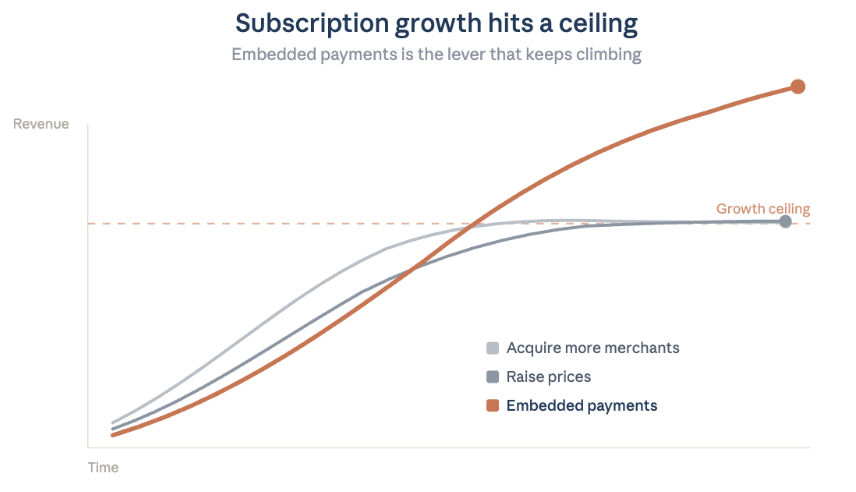
But if you rely on subscriptions alone, your growth will eventually hit a wall.
If you want to earn more subscription revenue, you generally have two options, and both come with their own problems.
- Firstly, you can acquire more merchants. But rising customer acquisition costs and increasing competition make this option harder and more expensive than it once was. You may need to spend more on marketing, sales, onboarding, and support just to maintain the same rate of customer growth.
- Secondly, you can charge your existing customers more by raising prices, introducing additional seat fees, or pushing them into higher subscription tiers.
Even when you’ve made meaningful product improvements, merchants may view a subscription increase as simply paying more for software they already use. You also risk creating frustration if customers feel they’re being forced into a more expensive plan to access features they consider essential.
Neither of these options scales indefinitely: there’s a limit to how much you can spend acquiring new merchants, and there’s a limit to how often you can increase prices before you begin to damage retention.
To avoid this growth ceiling, you need to look for revenue streams that scale automatically as your merchants become more successful.
Instead of asking merchants to pay more every year or continually spending resources to bring in new ones, you can participate in the economic activity already happening on your platform.
Alternative revenue models ISVs are exploring
There are several ways you can diversify your revenue beyond monthly subscriptions.
The right model will depend on your product, your customer base, and the type of activity taking place within your platform.
Here are some of the most common models to consider.
Usage-based pricing
With usage-based pricing, you charge users according to how much they consume your software.
That might mean charging based on API calls, stored data, messages sent, active contacts, documents processed, or another measurable unit of product usage.
For example, a developer platform may charge according to the number of API requests a customer makes or the number of gigabytes of cloud storage they use. An email platform might charge according to the number of contacts stored or messages sent each month.
Pros: You create a lower barrier to entry for smaller users, while your revenue automatically increases as their product usage grows.
Cons: Your income may become less predictable and harder to forecast, which can make revenue planning more difficult.
Usage-based pricing can work particularly well when your product has a clear, measurable consumption unit. However, you also need to make sure customers understand what they’re being charged for and can predict their likely costs.
Transaction-based pricing
Instead of charging only a fixed subscription fee, you can take a small percentage or charge a flat fee whenever a business activity or transaction takes place through your platform.
In practice, this might look like salon scheduling software charging a small fee every time an end customer books a haircut, or a ticketing platform charging a fee every time an event ticket is sold.
The transaction doesn’t necessarily have to be a payment. It could be a booking, order, reservation, completed job, or another valuable action your software facilitates.
Pros: Your revenue becomes closely aligned with customer success. When your merchants complete more business through your platform, you make more money.
Cons: If your merchants experience a slow season or an economic downturn, your revenue may fall alongside theirs.
You also need to be careful that transaction fees don’t make your platform feel disproportionately expensive for high-volume customers.
Premium features and value-added services
You can keep your core software accessible while monetizing high-value functionality and value-added services separately.
This might include advanced reporting, custom workflows, additional integrations, enterprise controls, automation tools, AI capabilities, priority support, or managed implementation services.
For example, a project management platform might include basic task tracking in its standard plan but charge extra for custom AI automation, advanced resource planning, or enterprise analytics.
Pros: You can increase account value organically without forcing every customer onto an expensive base plan.
Cons: Gating too many helpful features behind additional paywalls can frustrate core users and reduce overall product adoption.
The strongest add-on strategies usually reserve genuinely specialized or resource-intensive functionality for premium plans, rather than charging extra for features customers consider essential.
Marketplace, referral model, and partnership revenue
You can partner with third-party providers, such as payroll, accounting, insurance, shipping, or inventory software companies, and earn a referral commission whenever your merchants sign up through your platform.
A common example is an e-commerce platform earning a commission when a store owner installs an integrated third-party shipping or accounting application.
You might also build a wider application marketplace in which third-party developers pay listing fees, share subscription revenue, or pay you a percentage of sales generated through your platform.
Under a referral model, you introduce your merchants to a third-party provider and earn revenue when they sign up or begin using the service. A deeper referral partnership may also include joint marketing, integrated onboarding, shared customer support, or negotiated commercial terms.
Pros: You can generate additional revenue without having to build or maintain every piece of software yourself.
Cons: You hand some control over the customer experience to third parties, and your margins depend on partner commission terms.
A poor partner experience can also reflect badly on your brand, even when you don’t directly control the third-party product.
Embedded financial services
Instead of sending users elsewhere to complete financial tasks, you can embed financial services directly into the workflows they already rely on.
These services can include payment processing, invoicing, lending, banking tools, expense management, insurance, card issuing, digital wallets, mobile payments, or buy now, pay later options.
Collectively, these capabilities are often described as embedded finance.
For example, a field-service management platform could allow contractors to create invoices and collect credit card or mobile payments without leaving the job management application.
An e-commerce platform could offer merchants access to working capital based on their transaction history. A property management platform could allow landlords to collect rent, pay contractors, and manage deposits inside one system.
A retail platform might support digital wallets at checkout or give eligible customers access to buy now, pay later options without redirecting them to a separate provider.
Pros: You can unlock higher customer lifetime value and make your software a more central part of your merchants’ day-to-day operations.
Cons: You need the right infrastructure partner to avoid taking on unnecessary compliance requirements, operational risk, and technical overhead.
Each of these models can play a role in a diversified revenue strategy.
However, if payments are already happening through or alongside your platform, embedded payments can offer a particularly direct and scalable opportunity.
How SaaS platforms can leverage embedded payments to fuel growth
Embedded payments give you a way to earn revenue from activity already taking place through your platform.
If you rely on traditional merchant service providers, your merchants may process millions of dollars through your software while most or all of the payment revenue goes to the provider. You facilitate the transaction, own the customer relationship, and provide the workflow, but may receive no financial benefit from the payment itself.
By working with a provider that supports revenue sharing, you can capture a portion of those payment economics while still delivering a seamless experience for your merchants.
Here are three reasons embedded payments can be such a powerful revenue model for your platform.
Your revenue grows as your merchants grow
Consider two merchants that each pay $199 per month for your software.
Merchant A processes $10,000 in monthly card payments, while Merchant B processes $1 million. Under a subscription-only model, both may generate the same software revenue, even though Merchant B receives more value from your platform and creates more activity.
Embedded payments let you participate in that growth.
If Merchant A generates $100 in gross processing margin after interchange and network fees, your platform would earn $20 under a 20% revenue-sharing agreement. If Merchant B generates $10,000 in gross margin, you’d earn $2,000 under the same agreement.
These figures are illustrative, and the exact economics will depend on factors such as card type, transaction method, merchant pricing, processing costs, and your payments agreement.
Unlike traditional usage-based pricing, you’re not directly billing merchants for consuming more software. They can remain on the same subscription plan while your revenue grows with the transactions taking place through your platform.
You can increase account value without repeated price rises
Subscription growth often depends on adding seats, introducing usage limits, or pushing merchants into higher tiers.
But those measures can create friction and make your most successful customers feel penalized for growing.
Embedded payments give you another route. You can keep entry costs accessible for smaller merchants while earning more as their transaction volume increases.
Your highest-volume merchants naturally contribute more, helping offset the additional infrastructure and support they may require.
Shopify is one of the best-known examples of this model. While it started as an e-commerce software platform, a significant portion of its business now comes from Merchant Solutions, which includes payments and other commerce services.
You make your product more valuable to merchants
Without embedded payments, merchants may need to choose their own processor, open a separate account, configure an external integration, and manage transactions through another provider’s dashboard.
By bringing payment onboarding, transaction management, reporting, and support into your platform, you create a more unified experience.
A contractor could create a quote, complete a job, send an invoice, and collect payment without switching tools. A restaurant could manage orders, process card and mobile payments, issue refunds, and review transaction reports in one place.
Embedded payments can also give merchants more flexibility in how they manage processing costs. In some industries, they may choose to use convenience fees, service charges, or surcharges where permitted by applicable laws and card-network rules.
This approach isn’t suitable for every business, but it can make embedded payments easier to adopt in industries where customers are already accustomed to these fees.
Together, these benefits give you a revenue stream that scales with transaction volume while making your software more useful and harder to replace.
The importance of choosing the right payment partner
Your payment partner affects how much control, margin, and operational responsibility you have.
A rigid provider may limit your ability to tailor pricing by vertical, customer segment, or merchant size. One-size-fits-all rates can also reduce your margins, especially if you have little visibility into processing costs or how your revenue share is calculated.
The merchant experience matters too. Slow approvals, third-party portals, and poor support can create friction and reflect badly on your platform. When payment issues arise, merchants will usually contact you first, even if the problem sits with your provider.
When evaluating a payment partner, consider:
- The partnership model. A referral model usually requires less operational involvement but gives you less control. An ISO model can offer more commercial flexibility, while a PayFac model gives you greater control over onboarding and processing but may bring additional risk and compliance responsibilities.
- How much responsibility you want to take on. You don’t need to become a PayFac yourself. Many platforms work with a payment facilitator or processing partner that provides the infrastructure and handles much of the operational burden.
- What sits beyond the integration. A strong API is only one part of a successful payments program. You also need to understand how your partner handles underwriting, KYC and KYB, PCI compliance, fraud prevention, chargebacks, transaction monitoring, reporting, and merchant support.
- How transparent the economics are. Your partner should give you clear visibility into pricing, processing costs, and how your revenue share is calculated.
The right partner gives you flexible pricing, reliable infrastructure, transparent economics, and a native merchant experience while managing the complexity behind the scenes.
That’s what turns payment volume into a sustainable revenue stream.
How Fiska helps you monetize payments
Launching embedded payments can be one of the most impactful growth initiatives you undertake as a SaaS platform.
The challenge is that payments introduce complexity behind the scenes.
You need to think about merchant onboarding, underwriting, KYC and KYB requirements, PCI compliance, fraud prevention, risk management, pricing, reporting, support, and ongoing program optimization.
That’s where Fiska comes in.
Fiska is an embedded payments solution designed specifically for software platforms.
We help you launch, monetize, and scale embedded payments without requiring you to become a payments expert or build an entire payments operation internally.
When you partner with us, you benefit from the following.
A transparent revenue-share model built on interchange
One of the biggest difficulties when evaluating embedded payment providers is understanding how much revenue you’ll actually earn.
Many processors rely on blended or flat-rate pricing models that bundle multiple costs together.
This can make it difficult for you to see where margins are generated, how much the underlying transaction costs, and how much of the payment economics flow back to your platform.
We take a different approach.
Our revenue-share model is built on true interchange pricing, giving you visibility into the fees charged by card networks such as Visa and Mastercard.
Once those underlying network and processing costs are paid, the remaining gross margin is shared between your platform and Fiska.
For example, if one of your merchants processes $100,000 in card payments and the remaining gross margin after network costs is $500, your platform could receive $250 and Fiska could receive $250 under a 50/50 agreement.
The exact commercial terms of a payments program may vary, but the structure gives you a clear view of how the economics work.
You can understand the underlying costs, see the margin being generated, and determine how much revenue your platform receives.
Because we don’t charge hidden platform fees or monthly minimums, you retain more control over your margins and a larger share of the transactions processed through your platform.
This transparency also makes it easier for you to forecast the potential value of your payments program and compare commercial arrangements accurately.
Complete pricing and fee customization
Every software platform serves a different mix of merchants.
A pricing structure that works for a small local business may not be competitive for a high-volume enterprise merchant.
Similarly, a model that works well in one vertical may not make sense in another.
That’s why we give you the flexibility to design payment pricing structures that align with your business model and merchant base.
Rather than forcing you into a predefined markup structure, we allow you to customize processing rates at the vertical, customer-segment, or individual-merchant level.
This gives you more control over both merchant growth and platform profitability.
You might offer simple, predictable pricing to smaller merchants that value ease of understanding.
For larger merchants that demand greater transparency, you could offer interchange-plus pricing.
You can also create different pricing structures for online, in-person, digital wallet, and mobile payment transactions, or adjust pricing according to transaction volume and merchant risk.
This flexibility also allows you to incorporate payments into your broader software packaging.
For example, you could bundle payment capabilities into a premium subscription tier, offer different payment rates across plans, or use payment pricing as part of a negotiated enterprise agreement.
Instead of being constrained by a one-size-fits-all model, you can build a strategy around the needs of your merchants and the economics of your platform.
A fully white-labelled and native merchant experience
The merchant onboarding experience plays a significant role in how customers perceive your platform.
When merchants are redirected to third-party applications or unfamiliar payment portals, the experience can feel disconnected.
It can also introduce unnecessary friction.
Merchants may be asked to create a separate login, repeat information they’ve already provided, or manage their payment account through an interface that has little connection to your product.
We help you keep the payments experience under your brand.
From merchant onboarding and account management to payment checkouts and receipts, your merchants interact with an experience that feels native to your platform.
This consistency strengthens your brand while creating a more professional and trustworthy experience for merchants.
Instead of introducing another visible vendor into the relationship, payments become a natural extension of the software experience you’ve already built.
Behind the scenes, we handle the operational payment work while your merchants continue to engage with one unified platform.
This can make it easier for you to encourage adoption because merchants aren’t being asked to leave a trusted product and begin a separate relationship with an unfamiliar provider.
It also gives you greater control over the customer journey, allowing you to design payment onboarding around your own workflows and merchant needs.
Expert payment guidance without hiring an in-house team
Launching embedded payments involves more than integrating an API.
Merchant underwriting, KYC and KYB compliance, fraud prevention, PCI compliance, risk management, support operations, pricing strategy, and ongoing optimization all require specialized expertise.
Many software companies don’t have that expertise in-house, and building a full internal payments team can be expensive and time-consuming.
Rather than leaving you to build an entire operation from scratch, we act as an extension of your team.
We work alongside your product, engineering, operations, and commercial teams to help shape your payments strategy, optimize your pricing model, and navigate the day-to-day realities of running a payments program.
Our support doesn’t end after implementation. We continue to assist with onboarding, risk management, compliance requirements, merchant support, and program optimization.
That gives your team access to experienced payment specialists whenever they’re needed.
With support available through Slack, phone, and email, you gain a dedicated partner invested in helping your payments program grow.
By handling the operational burden of payments, we allow your product and engineering teams to stay focused on what they do best: building great software and delivering value to your merchants.
Building a revenue model that scales alongside your merchants
Fiska gives you the tools and expertise to launch a payment program without sacrificing your merchant experience or placing the full operational burden on your internal team.
If you’re evaluating new monetization opportunities, payments may be one of the most valuable revenue streams you’re not capturing today.
Ready to explore what embedded payments could look like for your platform?
Book a no-obligation call with our team to see how Fiska can help you launch a payments program that drives growth without sacrificing the merchant experience.
FAQ: Alternative revenue models for ISVs
How can embedded payments create a new revenue stream for your platform?
Embedded payments allow you to earn revenue from the payment-processing activity taking place through your software.
When your merchants accept payments through your platform, you can receive a share of the payment margin under your agreement with your processing partner.
As merchants process more transactions, your platform can generate more payment revenue, creating a recurring revenue stream that scales alongside customer growth.
What’s the difference between transaction-based pricing and revenue sharing?
Transaction-based pricing refers to the way you charge customers.
Under this model, you charge a fee or percentage based on transaction activity, such as bookings, sales, or completed payments.
Revenue sharing refers to how payment economics are divided between the parties involved in processing the transaction, such as your SaaS platform and your payments provider.
You can use transaction-based pricing without a payment revenue-sharing agreement, and you can earn payment revenue share without directly charging merchants a separate transaction fee.
What’s the most profitable revenue model for SaaS platforms?
The answer depends on your business model, customer base, product, and the type of activity taking place through your platform.
Usage-based pricing may work well when your software has a clear unit of consumption. Premium add-ons may be effective when you have specialized functionality customers are willing to pay more for. Referral revenue can work when complementary services are important to your users.
For platforms whose merchants accept payments, embedded payments can create one of the largest long-term revenue opportunities because the revenue can scale with transaction volume instead of remaining fixed like a traditional subscription fee.
The strongest model may also combine several revenue streams rather than relying on one alone.