

Finix pricing review: Pricing model, extra fees, and alternatives for SaaS

Patrick Huynh
CEO
If you’re interested in Finix and how their pricing structure works, you’ve likely outgrown your current payment provider that leaves your revenue on the table and your user experience in the hands of a third party. You’re searching for a way to actually monetize payments and get control over your strategy.
Finix is a popular choice for SaaS platforms and marketplaces that want to embed payments without the massive compliance burden of building a fintech company from scratch. By offering a Payfac-as-a-Service model, they handle the heavy lifting of risk management and KYC that usually stops software companies in their tracks.
But as you evaluate their fee structure, you might be struggling with a few specific frustrations:
- A lack of pricing control. You are likely frustrated by rigid, fixed fees that prevent you from setting your own margins. Being locked into a standard rate makes it impossible to adjust pricing based on merchant volume or pass costs through effectively, stalling your revenue growth.
- Disjointed merchant journeys. You might be worried about onboarding friction when users are redirected away from your application. Without a fully white-labeled setup, the transition from your core product to the payment signup feels like a clunky third-party add-on rather than a native feature.
- Hidden costs at scale. You are likely finding it difficult to weigh monthly fees and add-ons against long-term growth. Without a partner who prioritizes your unit economics, opaque minimums and extra feature charges can quickly eat away at the profit you should be keeping.
The goal of this guide is to break down exactly how Finix pricing works while showing you how it compares to alternatives like Fiska, Stripe, Worldpay, and Tilled.
In this article:
- How does Finix pricing work?
- How does Finix pricing compare to competitors?
- Fiska pricing: a true revenue share partnership
- Stripe pricing
- Worldpay for Platforms pricing
- Tilled pricing
Fiska is an embedded payment solution designed for SaaS, offering a true partnership where you maintain complete control over your pricing and branding. If you want to see how our true revenue share model compares to Finix, book a no-obligation call with our experts.
How does Finix pricing work?
Finix allows you to select a pricing model based on how much transparency you need into your unit economics. For platforms that prefer simplicity, their flat-rate option in the U.S. typically sits at 2.75% + $0.30 per transaction for major card brands.
While this fixed cost is easy to communicate to your merchants, it functions as a “black box” where you pay a set fee regardless of the actual cost of the transaction. If you require more visibility, their dynamic model uses an interchange-plus structure, which charges the raw interchange cost plus card brand fees and a Finix markup of 0.3% + $0.30.
This level of detail is critical if you plan to optimize margins, but you must also account for secondary costs that can accumulate as you scale. These include a 0.75% fee for ACH processing, a 0.4% additional charge for subscription billing, and $0.25 for every card network token update.
While they offer white-labeling for merchant portals and universal tokenization for cross-platform security, these features are often tied to specific tiers or add-on costs that should be calculated against your total transaction volume.
Read more: How to monetize payments for your SaaS platform
How does Finix pricing compare to competitors?
When you’re comparing embedded payment solutions, the technical “how-to” is often less important than the “how-much.” Here is how Finix stacks up against the broader market.
| Feature | Fiska | Finix | Stripe | WorldPay for Platforms | Tilled |
| Pricing structure | Interchange plus with true revenue share | Flat rate or interchange plus | Flat rate per-transaction fee | Configurable (fixed or %) | Interchange plus plus pricing with revenue share |
| Monthly platform fees | No | No | No | No | $500 to $30,000+ |
| Best for | SaaS platforms seeking pricing control and a true revenue share | Flexible hybrid pricing models | Quick setup and simple developer tools | Highly customized, enterprise-level contracts | High-volume businesses with massive scale |
Fiska pricing: a true revenue share partnership
Since we’re writing this blog, we’ll tell you a bit Fiska and what we can offer.
Fiska is an embedded payments provider that works exclusively with SaaS platforms. We founded Fiska because we saw too many software companies becoming “bill collectors” for Stripe rather than partners in the revenue. We believe payments should be a growth enabler, not an obstacle.
Here;s the benefits of using Fiska:
Set your own pricing and keep the margin
Most payment solutions for SaaS force you into a fixed rate. If they charge you 2.9%, and you want to make a 0.5% margin, you have to charge your merchants 3.4%. That makes you look expensive.
Fiska uses a true revenue share model based on interchange. You see exactly what the card networks charge, and the remaining revenue is split between us. Because you control the pricing your merchants see, you can vary rates by vertical or customer segment. You could even bundle payments into your monthly subscription fee to increase your vertical SaaS platform value.

Access dedicated expert guidance through Slack, email, or calls
We act as your fractional Head of Payments. With Finix or Stripe, you are often limited to a ticket-based system or 24/7 “emergency” support that doesn’t actually know your business.
Fiska provides a consultative partnership. You get level 1 and level 2 support. And if there’s a payment emergency you can’t fix with our help, we can even step in and talk to your merchants directly.
Rather than a few days for a support ticket and having to re-explain your business to a stranger, you can reach us directly via Slack, phone, or email. We learn your brand inside out so that when you have a question about your roadmap or pricing strategy, you’re talking to a partner who has skin in the game: we only win when you do.
Brand the entire payment experience as your own with full white-labelling
If you want to build a fully white-labeled payment experience, you shouldn’t have another provider’s logo popping up at checkout. This often makes your platform feel like a pass-through shell, which can significantly reduce the perceived value of your company to your merchants.
Finix offers a white-label portal, but Fiska supports white labeling across the entire flow, including onboarding forms and receipts. This keeps the user experience consistent, which reduces friction and helps improve merchant retention.
Create a unified experience across channels and simplify checkout with omnichannel payments
Your merchants are likely struggling with fragmented data because their in-person sales are trapped in a different system than their online dashboard.
When hardware and software don’t talk to each other, you force your customers to manually reconcile reports across disjointed silos. Fiska removes this friction with a single omnichannel payment API that connects web, mobile, and in-person payments through a single integration.
This unified architecture powered by universal tokenization allows customers to save their payment details once and reuse them securely across any merchant or channel on your platform. This also enables you to offer ‘big’ brand features like Amazon-style one-click checkout, helping your merchants reduce cart abandonment and drive higher repeat purchase rates.
Because we give you total control, you can even set different rates for different channels, such as a lower rate for in-person transactions and a higher one for online sales. This flexibility allows you to optimize for conversion while maximizing the revenue you earn from every transaction.
Read more: Why Fiska is the right fit for your SaaS business
Stripe pricing

Stripe is the default for most startups. Their pricing is a simple 2.9% + $0.30 for online transactions.
While Stripe Connect allows you to embed payments, the flat-rate model becomes a burden as you grow. If your merchants are doing $3 million a year, that 2.9% feels very different from what it did when they were doing $200k.
The problem with Stripe is that you’re locked into a pricing sheet with zero ability to set your own margins or pass costs through differently. If you want to earn a profit, you have to price above Stripe’s fixed rate, which can quickly make you uncompetitive. Because Stripe doesn’t offer a standard interchange-plus option for smaller platforms, you have no visibility into your actual costs.
The merchant experience suffers too. Unless you dedicate significant engineering resources to build a custom UI, your users are redirected to a Stripe-branded page during setup. This breaks the native feel of your software and introduces unnecessary onboarding friction.
When problems arise, you’re left chasing tickets. If a high-volume merchant has their funds frozen on a Friday afternoon, you’ll be stuck waiting for an automated response while your customer gets frustrated. Without a dedicated partner, you are single-handedly responsible for managing these merchant complaints.
Despite these hurdles, Stripe remains a powerhouse due to its extensive suite of developer-centric features:
- Multichannel payments supported by pre-certified hardware and built-in tokenization.
- Embedded payment flows through Stripe Connect for platforms.
- Comprehensive subscription billing and tax automation tools.
- Real-time reporting and financial reconciliation APIs.
- Global coverage with support for dozens of local payment methods.
Read more: When is it time to move away from Stripe?
Worldpay for Platforms pricing

Worldpay is a giant in the processing world and their “Platforms” offering is a direct competitor to Finix. They offer configurable pricing, meaning you can choose between fixed fees or percentage-based charging.
One major difference here is that Worldpay often requires a more traditional contract negotiation. This can make your total costs harder to estimate compared to Finix’s transparent online tables.
Worldpay operates as a massive global institution, which provides a high degree of stability and massive infrastructure for enterprise-level platforms. While they offer white-label APIs to manage sub-merchant underwriting and a single integration for all channels, the experience can feel rigid. You often trade the agile, consultative support of a dedicated ISV payment partner for the consistency of a global legacy processor.
- Omnichannel payments supported via a single global integration.
- White-label APIs for customized merchant onboarding and underwriting.
- Universal tokenization across online, in-store, and mobile channels.
- Configurable fee logic allowing you to set fees per merchant or portfolio.
- Stability and global reach suited for high-enterprise volume.
Tilled pricing
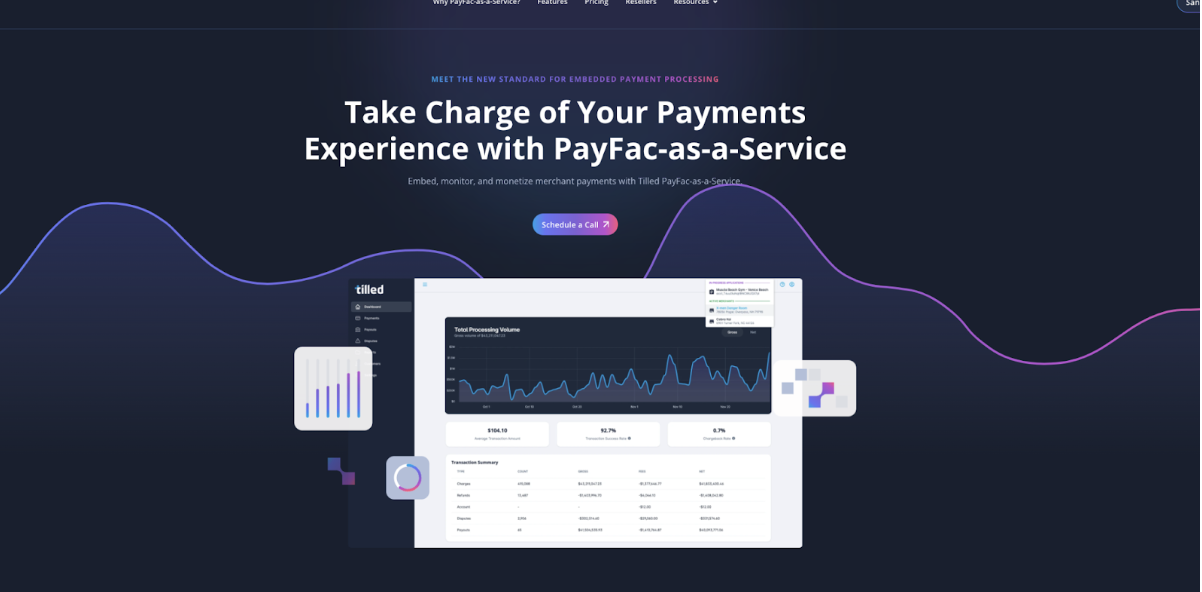
Tilled markets itself as “PayFac-as-a-Service,” specifically targeting companies that want to move away from Stripe Connect. They use an interchange-plus-plus model, but their pricing includes significant monthly platform fees.
Tilled offers several tiers:
- Start-up: 70% revenue share with a $500 monthly fee.
- Scaling: 80% revenue share with a $2,500 monthly fee.
- Enterprise: 95% revenue share with a $30,000 monthly fee.
They also charge a flat $0.05 per transaction. While high-volume platforms can potentially earn more through these tiers, smaller platforms may find the monthly minimums prohibitively expensive. If you aren’t processing enough volume, those monthly platform fees can easily wipe out any revenue you generate from payments.
Read more: Is payfac-as-a-service actually worth it for your company?
Choose the payments partner with pricing that is right for your business
Finix and its competitors all have strengths, but choosing the right one depends on whether you view payments as a utility or a growth driver. Stripe is great for day one, and Finix offers a solid hybrid model. However, many SaaS platforms eventually realize that “one-size-fits-all” pricing doesn’t work once they hit critical mass.
Fiska is for the 10% of platforms that need more than a box of tools. We provide:
- True revenue share: You earn when we do, with no hidden platform fees.
- Total brand control: You own the merchant onboarding and the checkout experience.
- Strategic alignment: You get a partner who understands your vertical and helps you optimize for customer acquisition first.
Ready to level up your payments strategy? Book a call with our payments experts to see how Fiska can help you turn payments into a recurring revenue stream.
Frequently Asked Questions (FAQ): Finix pricing for SaaS platforms
How do different payment processing models impact SaaS margins?
Payment processing typically follows flat-rate or interchange-plus pricing models. Flat rates simplify pricing but hide interchange fees and underlying costs, limiting margin control. Interchange-plus offers more transparent pricing, giving SaaS platforms the ability to set markups and optimise revenue as payment volume grows.
Solutions like Fiska build on this by combining interchange-based pricing with a true revenue share model, giving platforms more flexibility over how they monetise payments.
What fees should you expect from a payment processor like Finix?
In addition to standard credit card processing fees, SaaS platforms should account for add-ons such as ACH payouts, subscription billing, token updates, and chargeback handling. These processing fees can add up over time, especially for high-volume software platforms. Some providers, like Fiska, take a more transparent approach by minimising hidden platform fees and aligning pricing with your long-term unit economics.
What should SaaS platforms look for in a payments platform?
The right payments platform should offer flexible pricing, strong payment operations support, and full control over the user experience. Key features include white-label onboarding, multiple payment options (including debit and card-not-present transactions), and the ability to streamline payment processing without relying on third-party redirects. Platforms like Fiska are designed specifically for SaaS, offering full white-labelling and a more consultative partnership model.